
NSF STTR Phase I
Research partnership with a regional university, using the floor's telemetry as preliminary data.

A unified Unreal Engine ecosystem for location-based VR.
Platform·Flagship Experience·Creator Pipeline·one live public testbed, one engine
LAZRdojo × Ctrl V — Winston-Salem's high-end VR arcade + creative studio
Larry A. Stowe, Founder & Technical Director · UNCG alumnus · Winston-Salem, North Carolina
Unity → Unreal
A full-platform engine migration, built and tested in public
Why now
Ctrl V has operated location-based VR arcades since 2016. As the franchisee behind the Winston-Salem location, we've re-launched it as one company with LAZRdojo — a training studio that turns players into creators. The entire LBE software stack still runs on Unity: it works, but it's a closed, legacy system that can't support what comes next.
We are not asking Epic to start something. We are asking Epic to power the engine change.
The problem
Location-based VR runs on closed, legacy Unity toolchains. Fragmented, not social-first, no creator pathway, and invisible to the Unreal ecosystem.
The genre Fortnite defined — speed, verticality, building — still can't exist in VR. Motion sickness remains the #1 barrier to VR adoption and session length.
Comfort research happens in labs with tiny samples and single sessions. Studios test in dev rooms. No one iterates on real players, daily, at scale.
Root cause: gameplay, comfort research, hardware, and live deployment are solved by different groups who never share a room. VAMOS puts them in one building — on Unreal Engine.
The solution
Platform
Arcade operations, social VR lobbies, group launches, esports broadcast — the Unity stack rebuilt natively in Unreal. Not a launcher: a platform experience, deployable to VR arcades worldwide.
Experience
A VR-first, fast-paced multiplayer combat experience with an instrumented motion-comfort framework at its core. The proof that high-speed Unreal VR can work.
Pipeline
Students learn Unreal, ship into the live arcade, and publish to FAB. Players become creators become developers.
Testbed
A public venue where every layer deploys to real players, every day. One codebase, one engine, one feedback loop.
The core move
Running today — Unity
Rebuilt native — Unreal Engine
Deliverable to Epic: a documented, side-by-side Unity vs. Unreal migration case study for the entire LBE category — pipelines, performance, and developer experience, measured in a commercial environment.
Flagship experience
Not a port. A ground-up answer to why games with Fortnite-level intensity have never worked in VR.
Player-selectable comfort tiers — teleport, dash, smooth, arm-swing, and free-roam physical movement — blended in one framework.
Tanks, healers, snipers, rivals: intensity scales by role so players self-select their comfort and skill curve.
Gesture and radial building systems designed for hands, not thumbsticks.
Built for 17 simultaneous players on HTC Focus Vision headsets with LBSS tracking — hardware most studios never touch.
Every design decision doubles as an experiment — VAMOS is the vehicle for the research below.
The research engine
Cybersickness is the field's acknowledged #1 adoption barrier — the 2020 national R&D agenda led by Stanney et al. calls for exactly the kind of large-sample, longitudinal, real-world research academic labs cannot run. Typical lab studies: fewer than 30 participants, one session, university volunteers, consumer headsets. VAMOS instruments a public venue instead.
The Simulator Sickness Questionnaire — the field-standard instrument — built into every session.
Habituation data across repeat visitors, at population scale.
Across comfort tiers, ages, and experience levels — on identical enterprise hardware.
Deliverable to Epic: an open Motion Comfort Framework for Unreal Engine — reusable locomotion and comfort-scaling systems, validated on public players and published for the community, so every developer building fast-paced VR starts ahead.
Prior art validates the approach
Population: One
Proved battle royale, climbing, and building work in VR
Fidelity capped by standalone hardware; no comfort instrumentation
Sprint Vector (Survios)
Proved physical arm-swing locomotion lets the brain accept speed
Single mechanic; single genre; no longitudinal data
Hybrid locomotion systems
Proved multi-modal, player-selectable comfort tiers reduce dropout
Untested in fast multiplayer combat at arena scale
VAMOS operates in the untested regime: fast multiplayer combat · arena scale · public users · enterprise hardware (Focus Vision + LBSS) · instrumented, longitudinal data · Unreal Engine.
Creator pipeline
Play
The arcade sparks curiosity
Learn
Structured Unreal training built on the Dojo Code, including Unity-to-Unreal transition
Build
Team-based production on studio-grade workstations
Publish
Deploy to the live arcade, then to FAB
AI-assisted
The team and students work with AI tools across the whole pipeline — concept art and asset iteration, Blueprint and code assistance, and analysis of live playtest data. We teach it as professional craft: every shipped asset is human-reviewed, properly credited, and disclosed wherever the work is published. Students leave knowing how modern studios actually build.
Serving communities in western North Carolina that have never had access to studio-grade tools. Not just players. Creators — every graduate leaves an Unreal Engine developer.
The advantage
Play
Public players run real sessions on 17 stations, every day
Measure
Comfort, behavior, and performance data captured per session
Iterate
Devs and students refine mechanics the same week
Redeploy
Builds ship straight back to the floor — no publisher cycle
Game studios solve gameplay. Hardware makers solve tracking. Labs solve sickness. Engine makers solve tools. VAMOS is the only place all four run in one continuous, public feedback loop — on Unreal.
De-risked
Demonstrations included with submission: a live 17-player session run through Ruckus · the Unity vs. Unreal rebuild side-by-side · a student team building, deploying, and testing on the arcade floor.
What Epic receives
Motion Comfort Framework for UE
Open, reusable locomotion & comfort-scaling systems validated on public players
Control Room UE+ reference platform
A deployable Unreal-native LBE operations system — a first for the engine
Unity → Unreal migration case study
Documented pipelines, performance, and developer-experience comparison from a commercial migration
VAMOS showcase experience
Public proof of high-end, fast-paced Unreal VR on enterprise hardware
A developer pipeline + FAB output
New Unreal developers and student-shipped projects entering Epic's ecosystem
12 months · milestone-gated
Months 1–3
Architecture locked; core Control Room migration functional; live arcade running on the new stack in parallel.
Months 4–6
Social VR lobby shipped; VAMOS hybrid locomotion prototype in public testing with SSQ instrumentation live.
Months 7–9
Motion Comfort Framework v1 published; esports broadcast and cross-device systems on the floor.
Months 10–12
Public showcase event; migration case study delivered; first student projects published to FAB.
Funding can be tranched against these milestones. Each one produces demonstrable, on-the-floor output — not internal progress reports.
The ask
Funded outside the ask
<15%
Epic's share of total project value — every Epic dollar is leveraged more than 6:1
No Epic funds go to hardware, rent, or operations — those are carried by applicant capital, our nonprofit arm, and pending NSF and workforce grants. The $150K buys Unreal Engine software, systems, and research — deliverables Epic keeps.
Why Epic · Why North Carolina
The dominant free-roam LBE platforms run Unity-era stacks on the same HTC hardware we use — the engine is the open frontier, and we're crossing it in public.
No one has built the LBE operations layer — launchers, control rooms, session systems — natively in Unreal. Control Room UE+ is that first.
Unreal Engine is already taught at Atkins High School, minutes from our floor — we're the production studio those students graduate into. A UNCG-alumnus-led pipeline, 90 minutes from Epic's Cary headquarters.
Public, longitudinal motion-comfort research that advances the whole industry — published on Unreal first.
Players become creators. Creators become developers. Developers build on Unreal.
Epic built the tools that power the future of interactive experiences.
VAMOS builds the place where they are pushed to their limits — in public, every day.
We are not asking if fast-paced Unreal VR is possible. We are building the systems that make it work.
Requested: $150,000 · 12 months · milestone-gated
LAZRdojo × Ctrl V · Winston-Salem, NC
You Are the Source
This is the honest page. Everything below is either running on our 17-station floor with the public, built but rough, or not started yet — and it says which.
Last updated: September 2026. Current engine: Unity 6. Target: the latest Unreal Engine 5.
The networked core is done and public. Movement, story, and art are where the work is right now — which is the right order, because you can't tune a movement system without real players in a real match.
Every station on the floor in one match. Running with paying customers.
Headset players and desk players share one avatar representation, so hit resolution never branches on player type.
Hits resolve on the server with lag-compensated rewind. No client decides whether it landed.
Stations updated to current Unity tooling for the next-generation headsets. Full-body trackers under evaluation.
The locomotion director — the one thing allowed to move you — is in. Frames, dash, blend, and the speed-through-corners feel are still being tuned against real play.
Match data is being captured. The consent flow and the anonymized pipeline for the research study are still being built out.
Vam, the Level, and the Paste Squad are fully designed on paper. In-game, only the intro assets exist so far.
Five intro assets scoped, plus nine first-pass character models — spin them here. The Mega Man / Battle Chasers split isn't locked yet.
The core round loop runs. Rulesets, scoring, and spectator view are rough.
The three objective modes. Restore — the carry that destabilizes when you stop — is first, because it's the one the research needs most.
The arena lobby works today for other games. VAMOS isn't wired in as a session option yet.
Nothing exists in Unreal yet. The Unity build is the spec. Funding application submitted September 2026.
The free plugin for other Unreal developers. Depends on the UE5 rebuild.
Callsigns and belts that carry across visits. Design done; nothing built.
The padded zone exists. The LBSS colocation setup for headset-to-headset play in it does not yet.
Unlabeled footage is how early builds get oversold. Every clip below says what it is and what engine it's in.
We have a flat screen game that lets VR players play also in the same match. We will be solving some age old truths with this build. Who do you think is better?
Lots of action as we jump into our first build.
Here we are ramping up work to start full development of Project VAMOS for the LAZRdojo x Ctrl V arcade. More video to come. Big play testing tomorrow!
Below you can find people enjoying multiplayer VR games here!
Here we are designing and placing some of our first sets pieces for the game. A lot of the level blocking out has already been done. We are going with a bright semi realistic cartoony look. We are looking to have fun making this one. Realism is great but imagination is better. Plus we have student working on this with us! I’m so proud of them.
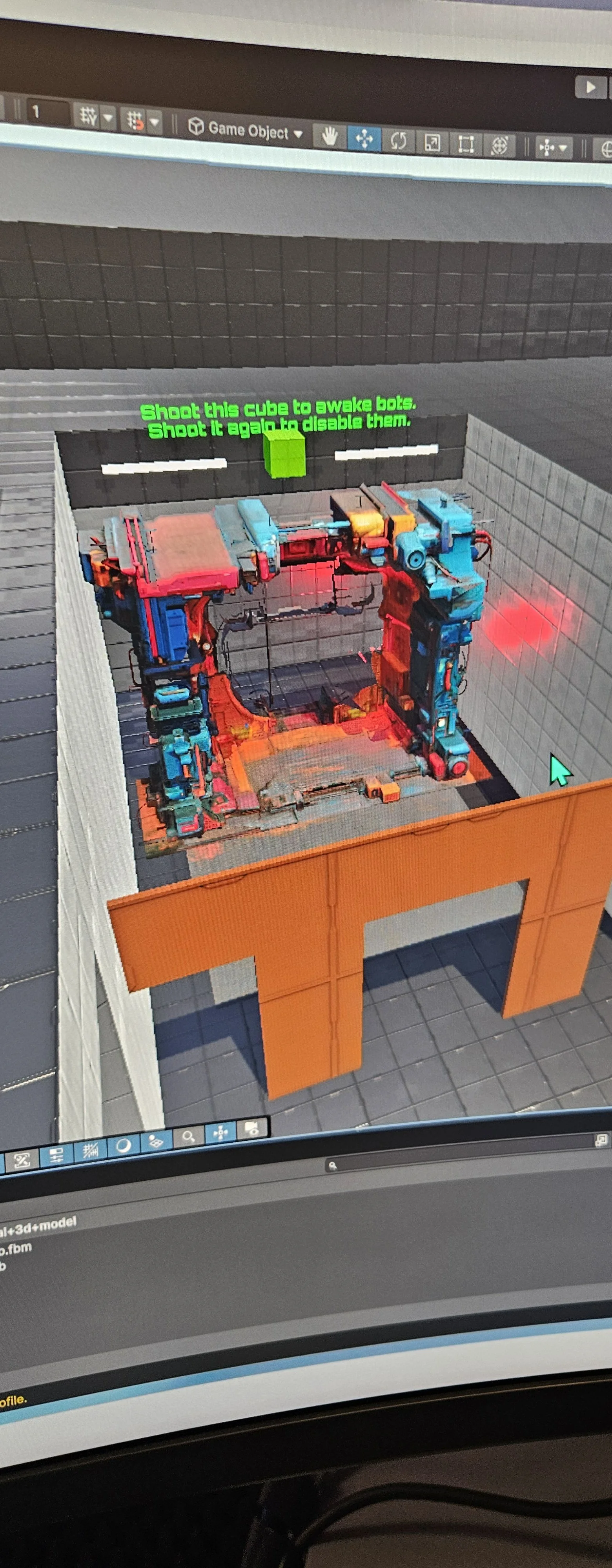
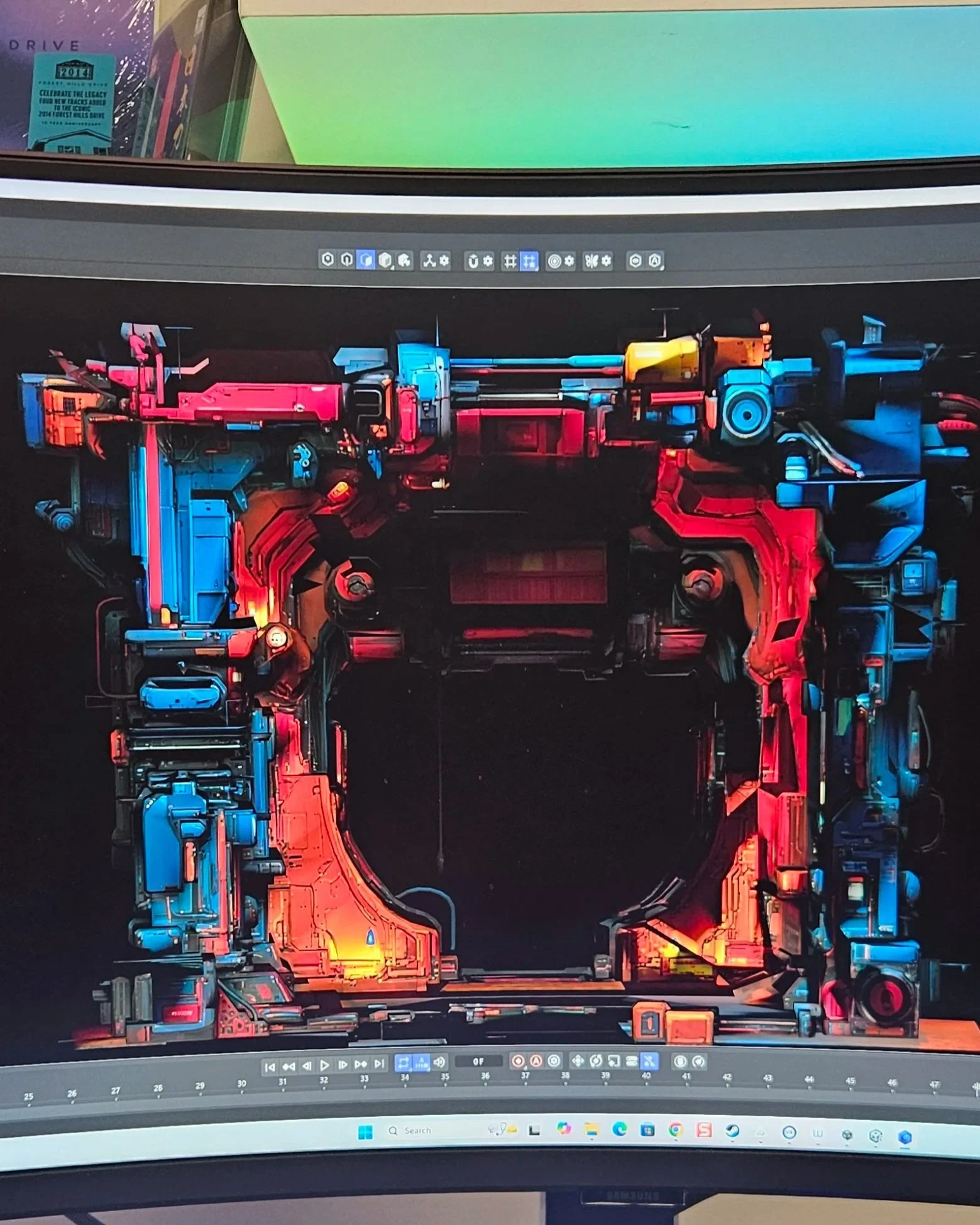
Add an entry whenever something lands on the floor. Keep it to what a visitor could see.
The movement system gets tuned against real matches until the off-axis frame feels like the thing the whole story promises. Then Restore — the carry that falls apart if you stop moving — because it's the mode that produces the fast play the research needs.
The Unreal rebuild starts when it's funded and when the Unity build has settled enough to be a real spec. Rebuilding a movement system that's still changing would mean rebuilding it twice.
See the project timelineA 17+ player VR and flatscreen arena shooter, built in the open on a public VR floor in Winston-Salem, to take on VR's oldest problem: fast motion makes people sick.
Early build Working: 17-player multiplayer · VR + flatscreen in one match Early: movement · story · art See what's working ›
LAZRdojo is a game-making incubator. VAMOS is its first big game — a homegrown North Carolina esport made by the people playing it right now. This page documents the whole project as it happens.
Watch the floor Book a sessionQuake-and-Unreal speed — momentum through corners, air control, real lines — has never had a proven design language in VR. Every studio that tried either slowed the game down or shipped it with an apologetic comfort menu for the players who couldn't hack the default.
We run a public VR floor. We watch this happen every week, to real people, on our own stations. So we're building the game that fixes it — and using the floor itself as the place we find out whether it works.
In VAMOS, your comfort settings aren't a menu. They're a frame — a block worn on your head, visible to everyone across the room. A frame's settings decide what motion you can do: how fast you accelerate, how hard you turn, whether you can carry speed through a corner.
Those same settings decide whether that motion makes you sick. So picking a frame is three things at once: a class choice, a movement ability, and — for our research — an experimental condition. They're the same numbers.
Nobody is choosing the "easy mode." A heavy frame is the anchor build your team needs to hold a point. A light frame goes places the heavy one can't and has a lot less to hold onto. Both are real builds, and a spectator can read them at a glance.
Faces square to the world. Agrees with the grid.
Turned forty-five degrees. Rests on a corner.
In New Dub City everyone is born wearing a block, and everyone wears theirs level. Streets meet at ninety degrees. Buildings stack. The civic virtue is called the Level: keep your frame straight, keep to the grid, and the ground stays under you.
Vam's block sits turned on its corner. It's not an injury and nobody's going to fix it. The kids call him Block Head. He calls himself Vam the Diamond, out loud, every time — and it changes nothing about how he's treated. He already knows who he is. He's waiting for everyone else to use the name.
Then something arrives that doesn't attack. It selects.
A district lights up inside a selection box. It's cut. A beat later it's back — wrong place, wrong scale, three of it where there was one. The Paste Squad doesn't want to destroy New Dub City. They want to organize it, and their idea of organization is duplication. Cut a block out of a city and it stops being held down. The whole place starts drifting upward.
You beat a thing that can only copy by doing something it can't copy. Nobody dies. Dupes get undone. This game has to survive a birthday party and a league night on the same floor.
Two uprights and a crossbeam — structurally, a frame. Spawn point, checkpoint, portal, and the LAZRdojo mark, all one prop. Passing through one re-grounds you.
The city lost its ground, so the levels are disconnected blocks hanging in sky. Classic arena geometry with a reason: there's no floor left to be slow on.
Where you train, get graded, pick your frame, and meet the crew. It survived the first cut because it was never quite on the grid either.
First-pass character models for the runners and the heavies. These are early — proportions, palettes, and the helmet tilt are all still being tuned against the art direction. But the silhouettes are there, and the silhouette is the whole point. Coming soon!
window.VAMOS_MODEL_BASE at the top of this Code Block to the URL where the models/ folder is hosted (see README). Until then this section is hidden.
Art direction assigns each reference a job: hard-edged clarity for Vam and the environment, exaggerated heroic proportion for the crew, silhouette weight for the villains. Outlines are geometry, not screen-space — screen-space linework breaks stereo in a headset.
Movement is Quake-and-Unreal lineage. Melee happens where two frames collide and destabilize each other — the mechanic threatens your frame, never your view.
Chase a cut district across the sky before it's pasted wrong.
Solo or co-op traversal, time trials against the dojo record. The mode for one walk-in and one free station.
The Paste Squad only respects what it can't copy — so it makes you prove it.
Old-school arena combat, free-for-all and team. The competitive core.
Carry a stolen block back to the slot it came from.
Capture-the-flag, rebuilt. The block destabilizes if it stops moving. Standing still loses it. Our flagship team mode.
Keep a re-grounded district attached while the crew reconnects it.
Objective mode. The mode where heavy frames are the stars.
The dojo grades by how much of your real body you bring. That's why one build serves every station on our floor as a story fact, not a porting compromise.
Seated PCVR. Frame assist at maximum. Entry class — anyone, first session, no clearance.
Standing room-scale. Partial assist, real turning. Where most of the crew lives.
Large-area free-roam. Real ground, real distance, minimum assist. Licensed dojos only.
Flatscreen. No frame. Precise, tireless, never out on the drifting part of the city. A combatant, not a spectator.
Footage from the LAZRdojo x Ctrl V floor. Current game build is Unity 6 on 17 workstation-class stations. Captions are set at the top of the Code Block.
The working build proves the design. It doesn't tell us how to write it in C++. Automated conversion produces code that runs and architecture that doesn't belong — and in a project whose whole value is measurement integrity, an awkward port is worse than no port.
The numbers a match already records to work — which frame you're wearing, how fast you moved, how hard you turned, the gap between where you looked and where you went, when you stopped, how long you stayed, when you came back — are the study's measurements.
Labs run single sessions with volunteers. Our floor has repeat visitors, across ages and experience levels, on controlled hardware, choosing their own comfort conditions because a match is on the line. That's a dataset a lab can't assemble, and it's why university partners are interested.
Built with our friends at Ctrl V, a location-based VR franchise running since 2015. We learned from them what actually works on a public VR floor — then built the floor everything else sits on.
VR and flatscreen in the same match. Comfort telemetry flowing. The Ctrl V lobby ready to launch it as a session option.
Applied under "Moving from Another Engine" to fund the UE5 rebuild and the free Fab release of the comfort framework.
Research partnership with a regional university, using the floor's telemetry as preliminary data.
The rebuild on the floor. The comfort framework out in the world. VAMOS running in a VR arcade that isn't ours.
Hi. I'm a Nintendo indie developer, a contractor for the DoD and the NCAA, and I've done some work as a motion graphics designer. As a teacher, I think of game design as an experience that has to be shared with people. I became a K–12 teacher to learn more about teaching our youth, then helped create LAZRdojo with the help of my good friends at Ctrl V. I've already updated their systems to use the newest tools from Unity so they work with next-generation HTC Vive headsets — and possibly full-body trackers.
I now combine all of that accumulated knowledge to create a game at the center of my game-creation incubator, LAZRdojo, to push the fun factor while trying to solve one of VR's biggest problems: fast-paced motion.
The first phase is my first massively multiplayer VR and flatscreen game, where your mode of play affects how you play — here at the arcade. The working title is VAMOS.
VAMOS is being built on a public floor in Winston-Salem, in the open, with the people who play it. That's the invitation. If you run an esports program, teach game design, study how bodies handle VR, or just want to be in the room when a movement system gets tuned — there's a place for you here.
Run VAMOS on your team's practice nights. Send students to learn Unreal Engine on a live shipping title instead of exercises. Bring a class to the floor and put a callsign on the dojo wall.
Human factors, kinesiology, computer science, game design — the floor produces repeat-visit comfort data a lab can't. Co-author the study. Bring your IRB. Send your grad students.
Playtest early builds. Tell us where the movement feels wrong. Earn belts that never reset. Every round you play is a data point that shapes what ships — and you're on the wall for it.